


— Our Work / Octopus Farming BanStopping Octopus Farming Before it Starts


Octopuses are truly extraordinary aquatic animals. They have charismatic and curious personalities, incredibly complex anatomies and are proven to be highly intelligent.
Despite this, the aquaculture industry is pushing for a new frontier: farming octopuses in captivity. This alarming attempt at forcing sentient, solitary creatures into intensive industrial agriculture systems comes amid growing evidence that the practice conflicts with animal welfare principles, sustainable development goals, and species conservation standards, with potential to cause lasting harm to the environment and public health.


Octopus farming represents the opposite of progress.
The effort to stop octopus farming before it starts is connected to the broader food systems reform our team is working toward, as it challenges entrenched narratives that treat the expansion of industrial animal production as inevitable or desirable, even when the species involved are fundamentally unsuited to confinement and intensive farming, simply because there may be misguided economic interest in doing so.
We are working across policy, certification, and scientific advocacy to prevent octopus farming before it reaches commercial scale, while simultaneously focusing on efforts in the corporate sector to preemptively ban the procurement of farmed octopus products. We believe that, in addition to keeping this cognitively complex, carnivorous, sentient species out of intensive farming systems, these efforts also build empathy and understanding among supply chain and legislative decision-makers, thus opening the door for broader recognition of aquatic animal welfare issues.
By stopping this practice before it starts, we aim to protect potentially hundreds of millions of cephalopods from entering industrial farming systems.
Do you want to protect octopuses?
➔ Join our Octopus Defenders community for information on how to support, access to the latest resources, and ways to take action worldwide.

In the News


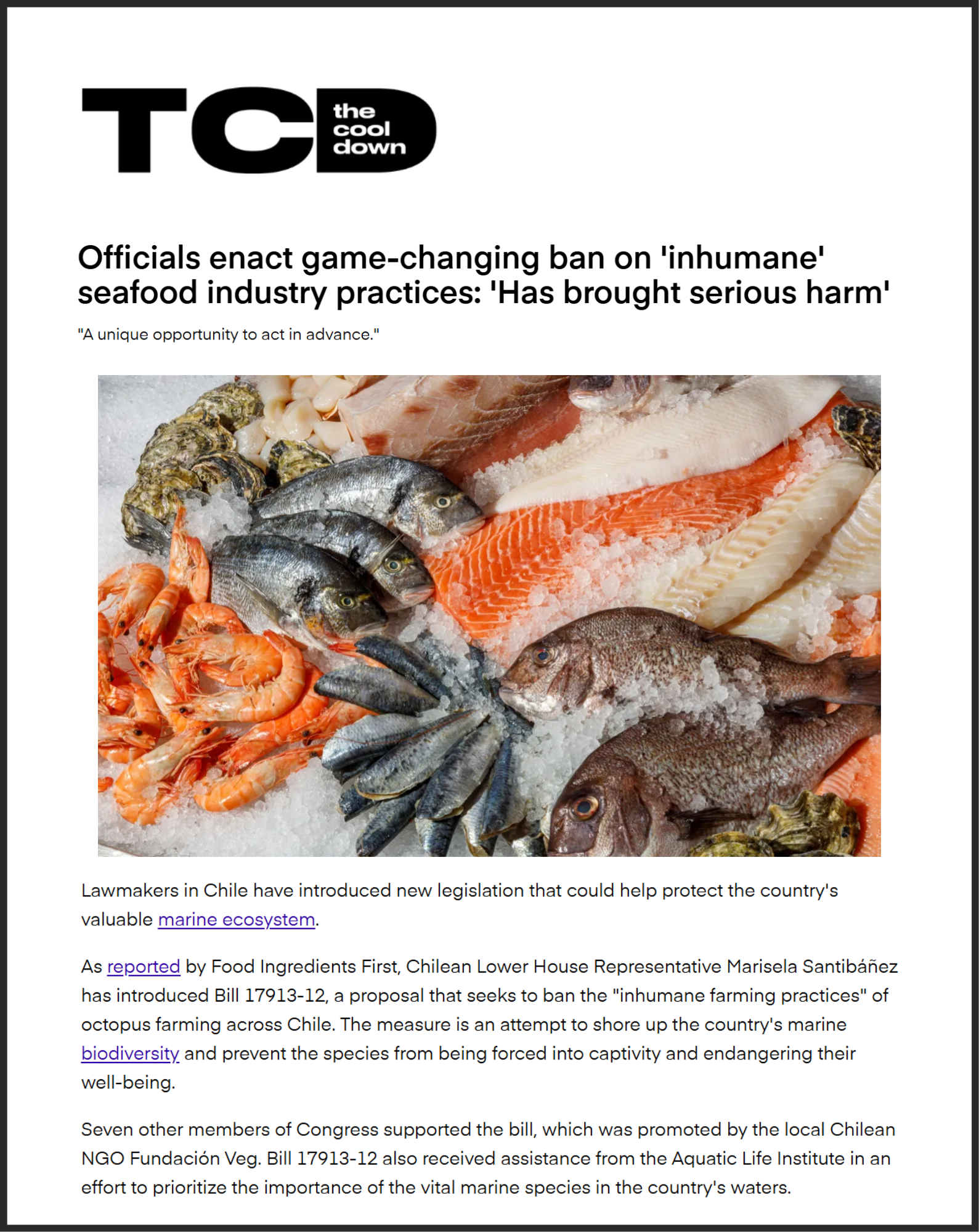


Signs of Progress
By providing compelling research, expert testimonies, technical reviews of policy language, media outreach, and proactively working with certification bodies, Aquatic Life Institute is helping drive the global effort to ban octopus farming worldwide, leading to:
laws passed, banning octopus farming in U.S. states California and Washington
2
state bills introduced in the U.S., including New Jersey, Hawaiʻi, Connecticut, Oregon,North Carolina, New York, and Massachusetts
7
5
commitments from leading seafood certification schemes explicitly prohibiting octopus farming through ALI’s Benchmark
6
Millions

reached through key media pieces examining the dangers of industrial octopus farming, including Vox’s The race to stop octopus farming before it starts; IFLScience’s The Big Questions: Are Octopuses Sentient?, and Futurism’s Efforts Grow to Ban Octopus Farming
The extreme environmental, welfare, and public health ripple effects of octopus farming

-
As an invertebrate with the most advanced brain, the octopus is the poster child for aquatic animal sentience and intelligence. The octopus has long-term memory, capable of retaining information and recognizing individual people, and they enjoy extensive foraging trips. To raise them in captive breeding environments with no cognitive stimulation, while denying them freedom to express natural behaviors, is morally misguided. Conditions of intensive farming and extreme confinement are inherently unsuitable for their well-being, leading to stress, aggression, and unnatural behaviors such as cannibalism. Furthermore, there are no approved humane slaughter methods for octopuses.
Read our Why Cephalopod Farming Must Be Rejected Before it Starts report

-
The overuse of antibiotics in aquaculture has been linked to the emergence of multidrug-resistant bacteria, with potential spillover effects into human populations. Some of the compounds in treatments for octopuses, e.g. malachite green, have even been banned in various EU member states.
Read our report on the world’s first proposed commercial octopus farm: Nueva Pescanova: Prioritizing Profits and Polluting Las Palmas

-
Octopuses are carnivores, requiring aquatic animal protein in their diets, thus farming them will further deplete fish stocks. An octopus’ food conversion ratio is approximately 3:1, meaning the weight of feed to sustain an octopus is around 3 times its weight. Nitrogen and phosphorus waste will be a product of the octopus farms, as will contamination from fertilizers, algaecides, herbicides, and disinfectants.
Read our Octopus Farming: A False Solution to a Real Crisis report

-
Due to the fact that octopus wild populations have been declining from overfishing, octopus farming is often presented as a ‘conservation effort.’ Our recent technical brief clearly illustrates that this would introduce ecological and ethical concerns that would harm both wild octopus populations and the broader environment.
Read our op-ed in Mongabay: Octopus farming is a dangerous detour for marine conservation

A Global Effort
Octopus farming prohibitions are gaining traction in several countries due to the collective and collaborative efforts of organizations worldwide. We are proud to support organizations, including Aquatic Animal Alliance members, that are actively working on introducing legislation in their regions.
-

Policy Reform
Pursuing legally binding statutes, regulations, or ordinances protecting aquatic animal welfare and influencing non-binding policies, principles, and frameworks at the international, intergovernmental level to shape global norms
-

Certification Program
Evaluating and ranking global seafood certification schemes’ aquatic animal welfare standards to drive “ripple effect” improvements across the supply chain
-

Corporate Engagement
Engaging major food retailers to adopt and implement higher aquatic animal welfare policies in their sourcing practices

Collective efforts highlight the power of teamwork in shaping impactful policy. By uniting diverse organizations and leveraging a breadth of expertise, we can effectively craft policies that preempt harmful practices against animals. Our joint initiative to ban octopus farming exemplifies this approach, demonstrating how collaborating with subject matter experts and strategic advocates like Aquatic Life Institute and its vast network can lead to significant advancements in policy-making.”
— Jennifer Hauge, Senior Legislative Affairs Manager, Animal Legal Defense Fund“

Contact

➔ Connect with our Head of Global Policy to collaborate on legislative and policy initiatives
Giulia Malerbi

➔ Reach out to our Director of the Aquatic Animal Alliance to explore collective action and support for efforts worldwide
Catalina López